
How Tube Bending Technology Has Evolved to Meet Modern Manufacturing Demands
From Manual Muscle to Modern Mastery For decades, tube bending has been a cornerstone in manufacturing — shaping materials for industries as diverse...
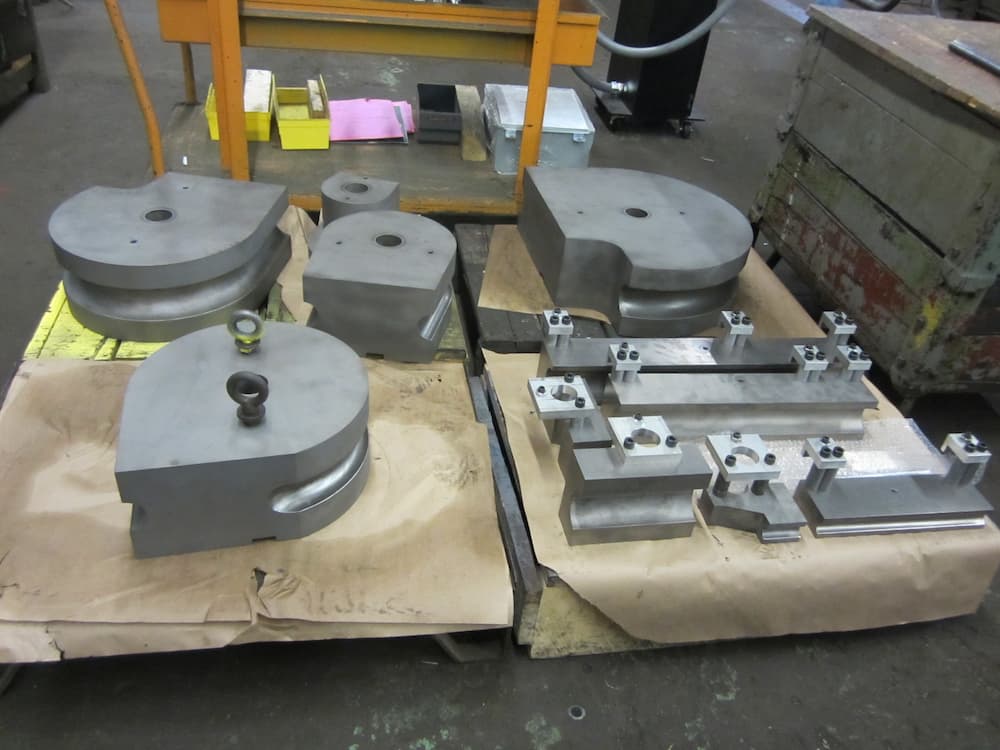
Custom Tube &Pipe Bending Tooling by H&H is built on more than six decades of engineering innovation. As a brand of Pines Engineering, H&H Tooling has set the benchmark for precision bending tools used in rotary draw and compression bending applications worldwide.
In tube and pipe bending, machine capability alone does not determine results. Tooling controls material flow, maintains dimensional accuracy, prevents wrinkling, and protects surface finish. Every bend radius, wall thickness, and centerline requirement depends on the quality and design of the tooling system.
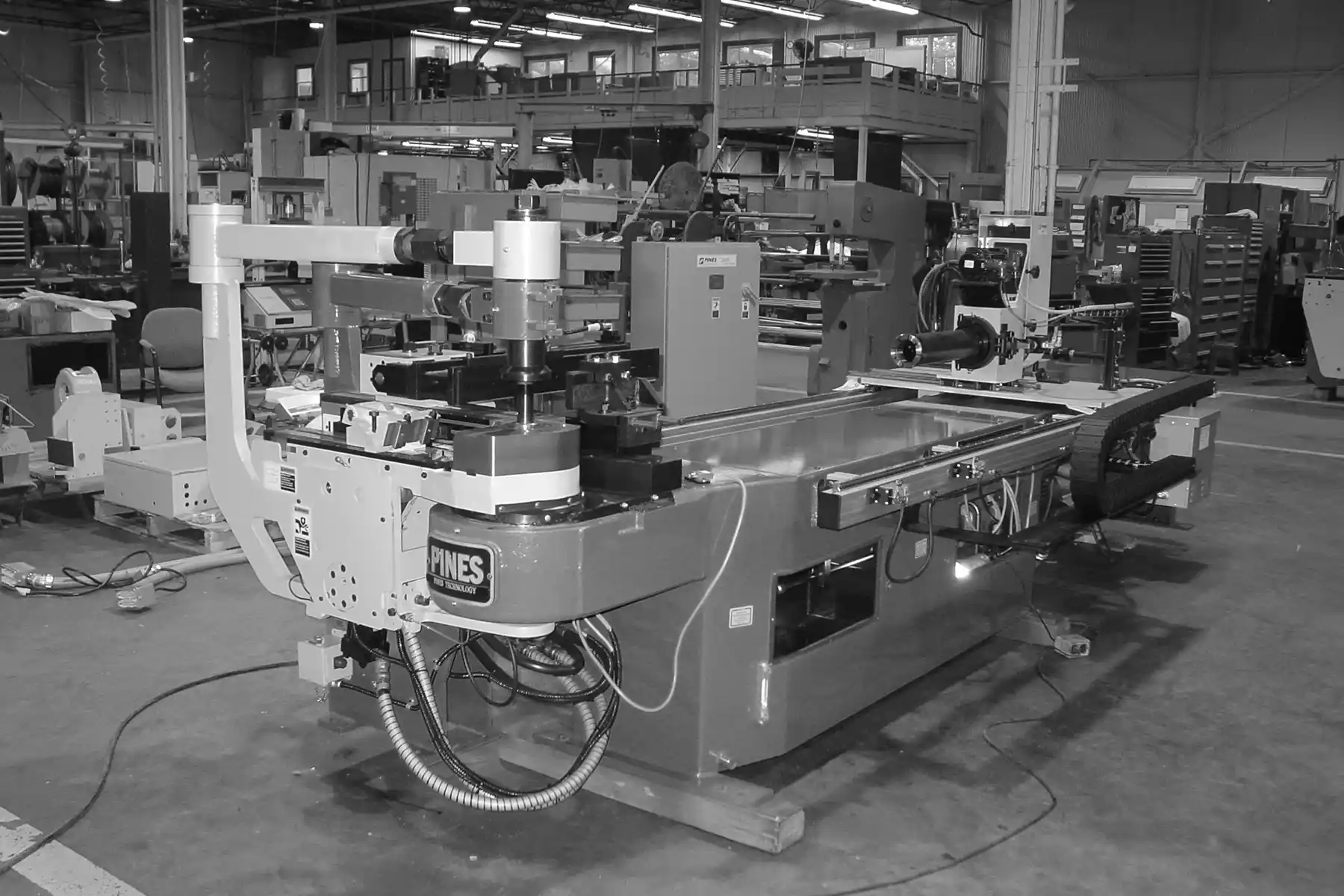
H&H designs and manufactures tooling not only for Pines benders, but for all major rotary and compression bending machines. Whether supporting new equipment or legacy machines, our engineering team develops custom tooling solutions that match the exact demands of your application —ensuring repeatable performance and long-term durability.
Performance in bending is not achieved by chance. It is engineered into every tool.
Innovation in tube bending tooling is not incremental — itis structural.
Originally designed and patented by H&H in 1963 (U.S. Patent 3457753), Interlock tooling redefined how bend dies, clamp dies, and pressure dies work together. Unlike conventional tooling systems, Interlock tooling features a self-aligning rail design that mechanically locks the clamp and pressure dies into the bend die.
This design delivers measurable advantages:
Because the pressure die weight is self-supporting at the bend tangent, alignment remains constant throughout the bending cycle. The result is smoother material flow, improved surface finish, and more consistent dimensional control — particularly in demanding thin-wall applications.
For manufacturers operating high-volume production or tight tolerance programs, this built-in alignment is not just a convenience — it is a performance safeguard.
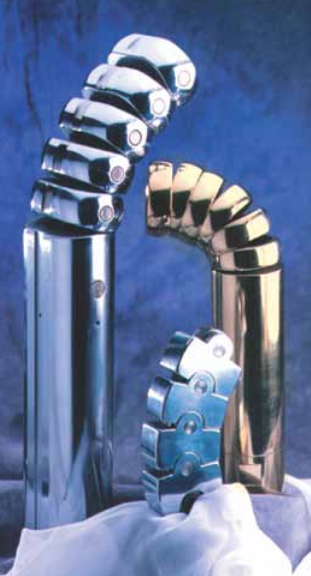
Patented by H&H Tooling in 1962 (U.S. Patents 3,190,106and 3,408,850), the Uni-Flex mandrel has become the global benchmark for internal ball-style mandrel systems. Its unique ball-and-socket linkage design allows the mandrel to flex in any plane, providing unmatched adaptability during complex and compound bends.
In rotary draw bending, internal support is critical —especially when working with thin-wall materials, tight centerline radii, or high-strength alloys. Without proper mandrel performance, wrinkling, collapse, or excessive wall thinning can occur.
The Uni-Flex system addresses these challenges by maintaining consistent internal support throughout the bend. Because the balls overlap and are engineered on precise pitch relative to tube diameter, wall integrity is preserved even in demanding geometries.
Unlike rigid mandrel systems, Uni-Flex assemblies offer:
The result is improved surface finish, tighter dimensional control, and reduced scrap — particularly in applications where wall factor and bend radius leave little margin for error.
For manufacturers working in stainless steel, Inconel, refrigeration serpentine assemblies, or thin-wall tubing, mandrel design is not optional. It is essential.
With Uni-Flex, that performance standard is built into the tooling itself.
As tube walls become thinner and bend radii become tighter, the margin for error disappears. In these applications, conventional tooling often struggles to control material flow at the vertical parting line — leading to extrusion, distortion, or excessive marking.
H&H addressed this challenge with Reverse Interlocking and Lipped Draw Bend Tooling — a refinement of the original Interlock system.
In reverse interlocking designs, the clamp and pressure dies engage differently with the bend die, maintaining consistent alignment while enhancing containment control. When paired with precision-machined lip extensions, this configuration helps prevent tubing from extruding at the parting line — a common issue in thin-wall and high-strength materials.
The benefits are particularly significant in:
By mechanically stabilizing the tooling relationship throughout the bending cycle, Reverse Interlock systems improve repeatability while compensating for minor machine wear and material inconsistencies.
For demanding bend programs, this design refinement can mean the difference between acceptable performance and engineered precision.
High-performance tube bending is never the result of a single component. It is the coordinated interaction of the entire tooling system — each element engineered to control material flow, maintain dimensional accuracy, and protect surface integrity throughout the bend cycle.
In a standard draw bending configuration, five primary components work together:
While these components are common across the industry, performance is not.
The geometry, material selection, surface treatment, and integration of each tool directly influence outcomes such as:
At H&H, tooling is not manufactured as isolated pieces —it is engineered as a unified system. Each tool is designed with consideration for the others, ensuring controlled material flow from clamp engagement through pressure die follow and internal mandrel support.
This system-level approach reduces setup variability, minimizes scrap, and improves consistency — particularly in demanding applications involving thin-wall tubing, high-strength alloys, or compound bends.
In bending, every component matters. But it is the precision of their interaction that defines performance.
For a complete overview of available bend die styles, Uni-Flex mandrel configurations, Interlock tooling systems, compression tooling options, and stocked components, download the H&H Tooling Brochure.
View the H&H Tooling Brochure →
From patented Interlock systems to industry-standard Uni-Flex mandrels, H&H continues to advance the performance of custom tube and pipe bending tooling across rotary and compression platforms.
Every bend presents unique challenges — material behavior, wall thickness, centerline radius, and production volume all influence tooling requirements. That is why H&H designs and manufactures tooling tailored to the exact specifications of your application, whether supporting new equipment or legacy machines.
When tooling is engineered correctly, setup time decreases, scrap is reduced, and performance becomes predictable.
In tube and pipe bending, precision is not optional. It is built into every tool.
Whether you require new tooling for a Pines bender, support for legacy equipment, or tooling for another OEM machine, our engineering team is ready to assist.
From Manual Muscle to Modern Mastery For decades, tube bending has been a cornerstone in manufacturing — shaping materials for industries as diverse...
In the aerospace industry, precision and reliability are not simply best practices—they are life-critical. Whether for commercial airliners, military...
How Bending Eliminates Production Bottlenecks and Increases Efficiency For decades, welding has been an integral part of metal fabrication. While...
Contact us today for more information about customization options, pricing, or details about purchasing a Pines machine, tooling, parts, or services.