
Serpentine Coil Bender Delivered
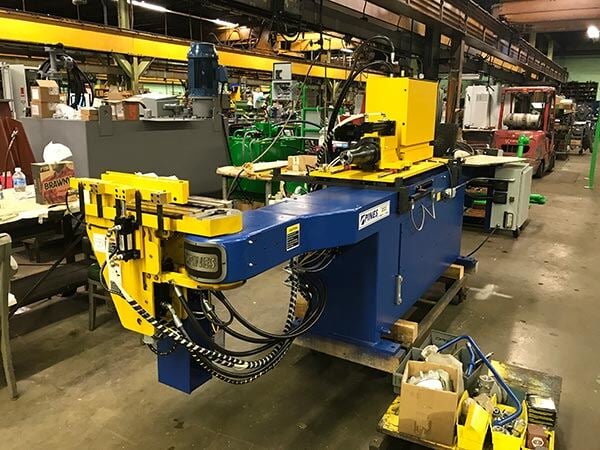
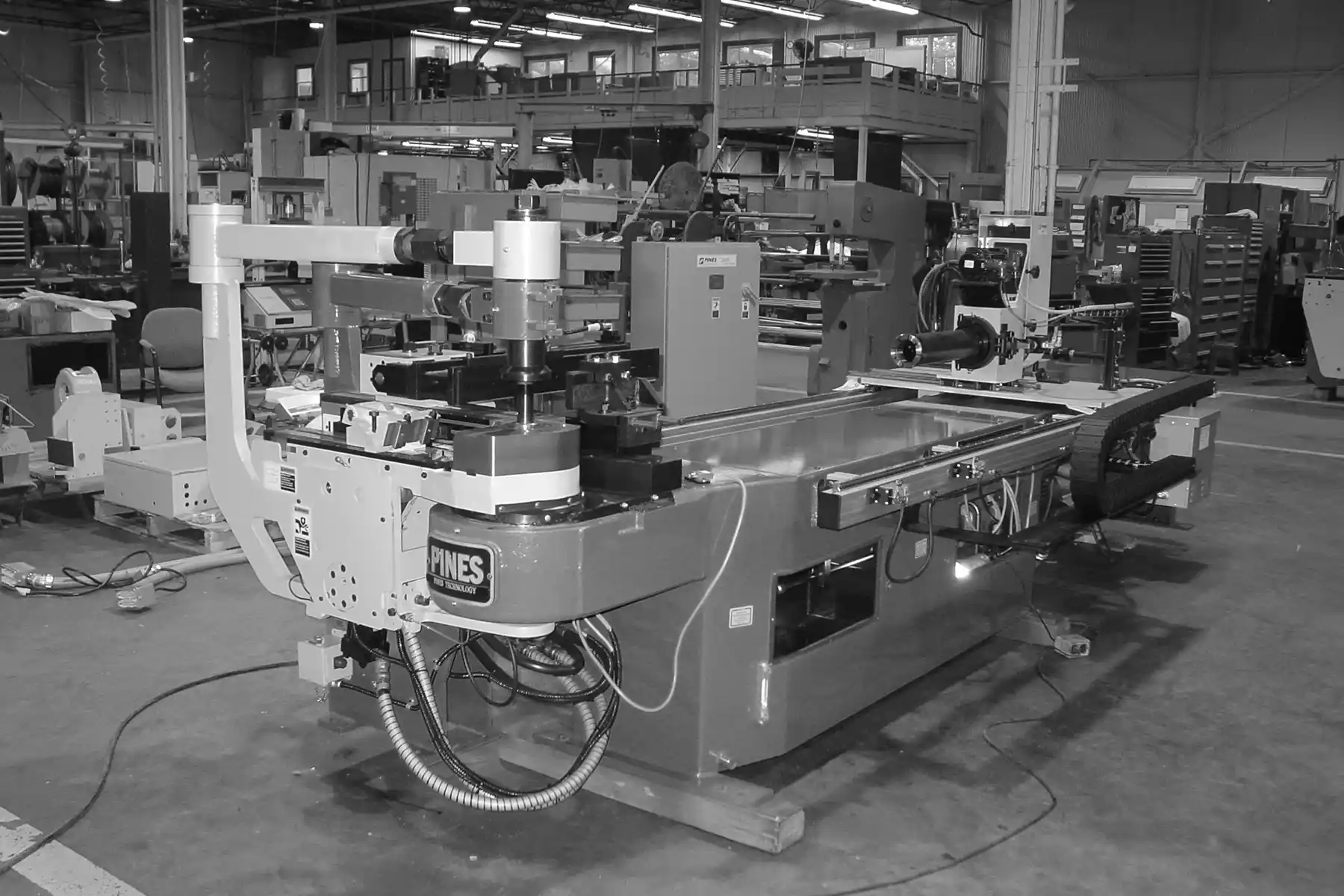
Pines has taken a standard #1 NC bender and added an automated feed system. The powered traction feed rolls precisely position the tube prior to...
Selecting tube bending equipment is not a one-size-fits-all decision. Material type, wall thickness, bend geometry, tolerance requirements, production volume, and long-term service expectations all influence which bending solution is the best fit for a given application.
Manufacturers today often evaluate multiple machine configurations—including electric, hybrid, and manual systems—to ensure the selected equipment aligns with both part requirements and production goals. Each approach offers distinct capabilities, and understanding how those capabilities match the application is a critical step in the equipment selection process.
At Pines Engineering, machine selection is driven by application requirements rather than a single preferred technology. Pines designs and manufactures a range of tube bending machines to support high-precision production, flexible job-shop environments, and specialized bending applications. This application-first approach helps customers invest in equipment that supports consistency, efficiency, and long-term value.
Modern tube bending applications span a wide range of materials, part complexities, and production volumes. To support those varying requirements, different tube bending technologies are used—each with characteristics that make them suitable for specific manufacturing environments.
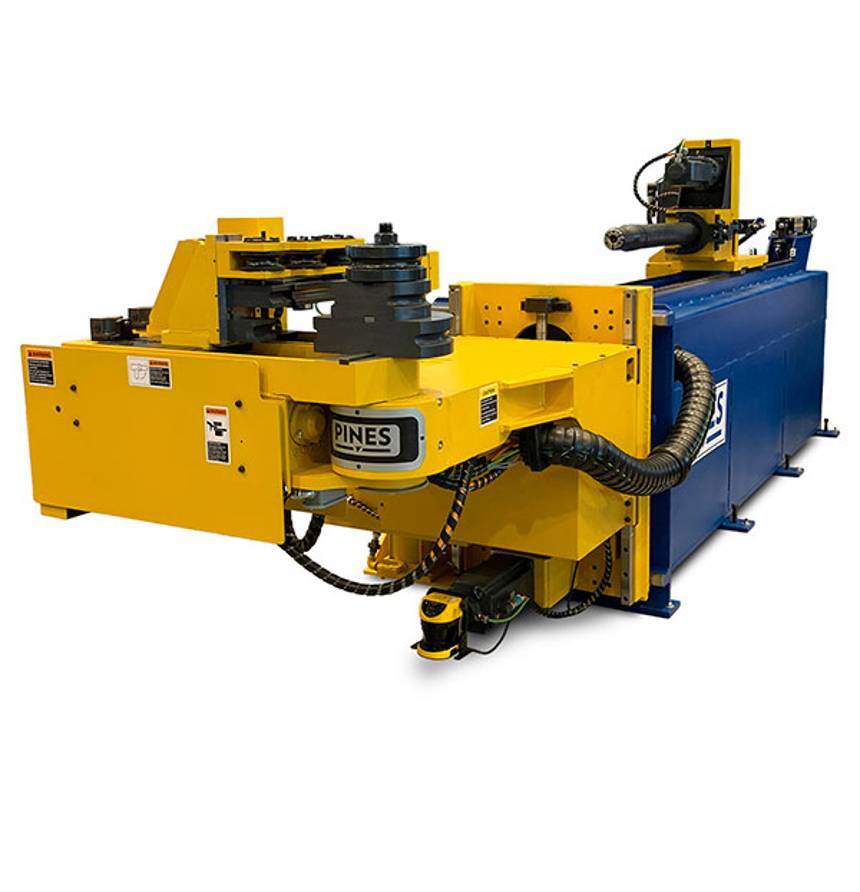
Pines Engineering designs and manufactures tube bending machines across three primary technology categories: all-electric, hybrid, and manual. Understanding how these systems differ helps manufacturers evaluate which approach best aligns with their application needs.
All-electric tube benders use servo-driven motion for bending, feeding, and rotation. These systems are commonly selected for applications that prioritize precision, repeatability, and efficiency in high-volume or tightly controlled production environments.
All-electric machines are often used when applications require:
Hybrid tube benders combine electric motion control with additional mechanical force capability to support a broader range of materials and part geometries. This approach allows manufacturers to balance precision with flexibility when applications vary across part families or material types.
Hybrid systems are often considered for:
Manual tube bending machines are typically used for lower-volume production, prototyping, or specialized applications where flexibility and operator control are key considerations. These systems can be well-suited for job shops, custom fabrication, and applications where automation is not required.
Manual bending solutions are commonly applied in:
No single tube bending technology is ideal for every application. Electric, hybrid, and manual systems each serve distinct roles depending on production goals, part complexity, and long-term operational strategy. Offering multiple machine types allows Pines to focus on matching technology to application, rather than forcing applications to fit a single solution.
Tube bending machine selection is driven by the specific demands of the part being produced. Material properties, bend complexity, production volume, and tolerance expectations all play a role in determining which technology is the best fit for a given application.
Rather than starting with a machine type, many manufacturers begin by evaluating application requirements and then matching those needs to the appropriate bending solution.
Material type and wall thickness significantly influence bending force requirements and process stability. Softer materials or thin-wall tubing may be well-suited for highly controlled electric bending systems, while applications involving thicker walls or varying material grades may benefit from additional force capability and flexibility.
Matching the machine’s force and control characteristics to the material helps support consistent bend quality and tooling performance.
Part design also plays a key role in machine selection. Multi-bend parts, tight radii, or complex geometries may require precise coordination between bending, feeding, and rotation. In these cases, motion control, repeatability, and machine rigidity become important considerations.
Applications with simpler geometries or lower complexity may not require the same level of automation, making alternative machine configurations a practical option.
Production volume often determines the level of automation required. High-volume programs may prioritize repeatability, speed, and process consistency, while lower-volume or mixed production environments may value flexibility and quick changeovers.
Selecting equipment that aligns with expected production demands helps manufacturers balance efficiency with operational cost.
Across all tube bending technologies, tooling plays a critical role in achieving consistent, repeatable results. While machines provide motion and control, tooling directly interfaces with the tube, influencing bend quality, surface finish, and dimensional accuracy.
Tooling considerations—such as die design, fit, and condition—apply regardless of whether an application is running on an electric, hybrid, or manual machine. Because of this, tooling is often a key focus area when manufacturers evaluate performance, troubleshoot bending challenges, or plan for future production needs.
A closer look at tooling design and selection is an important next step when optimizing any tube bending process.
Tube bending applications exist across a wide range of industries, each with its own combination of materials, part designs, quality expectations, and production environments. While industry standards and common practices provide helpful context, specific requirements often vary significantly from one application to another.
Because of this variability, industry classification alone is rarely enough to determine the right tube bending solution. Instead, machine selection is most effective when it considers the actual demands of the part, the production process, and the operating environment.
Pines Engineering supports tube bending applications across aerospace, defense, heavy industrial, automotive, and transportation markets by focusing on application-specific requirements rather than broad industry assumptions.
Selecting tube bending equipment is ultimately about aligning machine capability with real production requirements. Electric, hybrid, and manual bending systems each serve a purpose, and the right choice depends on how a specific application balances precision, flexibility, throughput, and long-term operational needs.
Rather than promoting a single technology, Pines Engineering works with customers to evaluate application details, production goals, and future considerations before recommending a solution. This engineering-led approach helps ensure equipment investments support both immediate performance expectations and long-term value.
For manufacturers evaluating tube bending options, a technical discussion can help clarify tradeoffs, identify opportunities for optimization, and determine the best path forward based on application needs—not assumptions.
Pines has taken a standard #1 NC bender and added an automated feed system. The powered traction feed rolls precisely position the tube prior to...
In automotive manufacturing, precision is everything. A single misaligned tube or poorly bent exhaust line can compromise performance, emissions...
How Bending Eliminates Production Bottlenecks and Increases Efficiency For decades, welding has been an integral part of metal fabrication. While...
Contact us today for more information about customization options, pricing, or details about purchasing a Pines machine, tooling, parts, or services.